Source-to-Pay and Procurement Software
Source-to-pay is an umbrella term covering a set of distinct products, not a single system. The savings percentages quoted in this market are almost always identified savings rather than money that reaches the financial statements. Meanwhile mandatory electronic invoicing is making part of this stack a compliance requirement rather than a discretionary purchase.
Source-to-pay is a marketing umbrella. Name the specific capability you need before shortlisting, or you will compare quotes that cover different scopes.
Identified savings are not realized savings. A negotiated rate becomes value only if buyers actually purchase on contract. Ask any vendor which of the two its case is built on.
Spend data quality is the hidden dependency. Classification and supplier normalization determine whether the analytics above them mean anything.
Electronic invoicing is no longer discretionary. For companies operating in the European Union and several other jurisdictions, the downstream investment is now a compliance obligation with dated deadlines.
Tail spend is a different problem. The sourcing playbook that works on managed categories does not scale down to thousands of small transactions, and applying it anyway is how procurement teams lose years.
Market overview
Executive summary
Source-to-pay is an umbrella term, not a product. It covers an upstream group concerned with deciding what to buy and from whom, comprising spend analytics, electronic sourcing, contract lifecycle management, and supplier information and performance management, and a downstream group concerned with executing and paying, comprising requisitions, purchase orders, receipts, invoice matching, and increasingly electronic invoicing. Two things decide whether a purchase in this market succeeds. The first is the quality of the underlying spend data, since every upstream capability degrades to guesswork without it. The second is whether the organization measures savings that reach the financial statements rather than savings that are negotiated and then quietly leak away, because vendor business cases are built almost entirely on the latter.
What are the actual categories, and what does each one do?
The upstream side, often called source-to-contract, begins with spend analytics: collecting purchasing data from across the organization, classifying it into categories, normalizing supplier records so that variations of the same company are recognized as one, and reporting what is actually being bought and from whom. This sounds administrative and is foundational, because sourcing priorities, negotiation leverage, and supplier consolidation all depend on knowing where the money goes.
Electronic sourcing manages the competitive event itself: requests for information, proposals and quotations, and in some cases reverse auctions, together with the evaluation and award. Contract lifecycle management holds the resulting agreements, manages authoring, negotiation, approval, storage, and renewal, and, in its more capable forms, makes contract terms available to the systems that need to enforce them. Supplier information and performance management maintains supplier master records, onboarding, qualification, and scorecards.
The downstream side, procure-to-pay, is the transactional half: a requisition is raised and approved, a purchase order is issued to the supplier, goods or services are received, and the supplier's invoice is matched against the order and the receipt before payment. Accounts payable automation extends this with invoice capture and workflow, and electronic invoicing connects it to the supplier and, increasingly, to a tax authority.
Two boundaries are worth stating explicitly. First, procure-to-pay is not procurement; it is the downstream subset, and an organization with excellent transactional discipline may still be sourcing badly. Second, the supplier management inside a source-to-pay suite is not the same thing as supplier risk software, which is a separate category concerned with financial distress, sanctions exposure, forced labor, and sub-tier mapping. The suite module maintains records and scores performance; the risk product monitors external data for exposure. SCR covers that category in its own guide and the distinction is worth preserving in requirements, because a suite module will not do the risk job and a risk product will not run your sourcing.
Table 1. Core functions against those commonly bought separately. Most scope disputes in a TMS procurement concern the last two rows rather than the first four.
Should I buy an integrated suite or point solutions?
The suites in this market are substantial and have absorbed a good deal of what were once separate products. Their case is the standard integration case, and in this market it is stronger than usual for one specific reason: the value chain here is strictly sequential. Spend analysis identifies an opportunity, sourcing runs the event, the contract records the outcome, and the transactional system enforces it at the point of purchase. Every handoff between those steps is a place where value leaks, and a single system with one supplier record and one contract repository removes several of those handoffs.
The specialists persist in areas where depth still exceeds what the suites offer. Spend analytics is one, because classification quality and the ability to handle messy multi-system data is a hard problem that rewards focus. Contract lifecycle management is another, partly because its buyer is often legal rather than procurement and its requirements are drafting and clause management rather than sourcing. Tail spend is a third, since it is frequently addressed by a service model rather than a licensed product.
The practical guidance is to sequence rather than to choose in the abstract. Organizations that start with the transactional layer often find they cannot say what they should be sourcing, while organizations that start with analytics can at least direct effort correctly even with manual downstream processes. Where regulation forces the downstream investment, as electronic invoicing now does in several jurisdictions, that sequencing argument is overridden by a deadline, which is a legitimate reason to do the downstream work first.
The fair case against the suite deserves a hearing. A suite ties several capabilities to one vendor's roadmap and pricing, and the modules acquired to complete the suite are frequently less mature than the specialist products they were bought to replace. An organization with one acute problem, such as classification quality or contract renewals, may get more value from a specialist that solves it well than from a broad platform that addresses it adequately. SCR covers the general form of this trade-off in its ERP versus best-of-breed guide, and the specific version here turns on how sequential your problems actually are.
Why do vendor savings claims rarely show up in my financial statements?
Because the savings being claimed are usually a different quantity from the one finance is looking for. Identified or negotiated savings is the difference between an old price and a newly agreed price, multiplied by expected volume. It is calculated when the contract is signed. Realized savings is the reduction in what the organization actually spends, visible in the accounts. The gap between the two is where most procurement credibility is lost, and it is not a rounding difference.
Several mechanisms drive the gap. Volumes may not materialize, so a rate improvement on an assumed quantity does not produce the modeled amount. Buyers may purchase outside the agreement, which is commonly called maverick or off-contract spend, so the negotiated rate is never applied. Prices may be entered correctly in the contract and incorrectly in the purchasing system, so the old price continues to be paid. Savings may be real but immediately consumed by additional spending elsewhere, so the budget never falls. Each of these is a leak between the upstream agreement and the downstream transaction, which is why the integration argument in section 03 is more than a convenience argument.
The measurement discipline that addresses this is straightforward to state and uncomfortable to adopt. Agree with finance in advance what counts as a saving and where it will be visible. Measure compliance to contract, meaning the share of eligible spend actually purchased under the negotiated agreement, and treat that as the primary operational metric rather than the negotiated rate. Report realized savings against a baseline finance recognizes. Organizations that do this generally report lower savings numbers than those that do not, which is a sign of honesty rather than of weaker performance.
SCR does not publish a benchmark for savings from procurement software, and buyers should be skeptical of the figures they are shown. The percentages circulating in this market originate with software vendors and consultancies that sell implementation services, they are almost universally based on identified rather than realized savings, and they are rarely accompanied by a defined baseline or method. The absence of a credible independent benchmark is itself the useful finding, because it means the only defensible business case is one built on your own measured baseline.
The fair case against savings skepticism is worth stating, because taken too far it undersells the category. A good deal of the value here is control rather than price: enforced approval workflows, an auditable record of who committed the organization to what, visibility of spend that was previously invisible, and, increasingly, compliance with invoicing rules that carry penalties. None of that appears as a savings percentage, and for many organizations it is the stronger part of the case.
What is tail spend, and why does it need a different approach?
Tail spend is the long tail of purchasing: a large number of low-value transactions, spread across many suppliers and categories, which collectively represent a meaningful amount of money but individually justify no sourcing attention. It is characterized by high transaction count, low value per transaction, high supplier count, and little or no category management.
The reason it needs a different approach is arithmetic. Competitive sourcing has a fixed cost per event, in analyst time, supplier engagement, and evaluation, and that cost does not fall in proportion to the value of the spend being sourced. Applying the managed-category playbook to a tail category costs more than it saves. Procurement teams nonetheless attempt it regularly, because the tail is visibly disorganized and disorganization invites intervention.
The approaches that work change the channel rather than sourcing each category. Consolidating tail purchasing onto a small number of catalogs or marketplaces where prices are pre-agreed removes the need for an event per purchase. Setting policy thresholds so that low-value purchases follow a light process rather than the full sourcing process reduces the internal cost. Outsourcing tail management to a service provider transfers the transaction handling. And guided buying, where the purchasing system steers a requester toward a preferred supplier at the point of need, addresses the tail at the moment it is created rather than afterward.
The practical error to avoid is treating the tail as a data problem to be reported on. Better tail visibility is easy to buy and changes nothing on its own, because the tail is generated by many people making small decisions outside any process. Unless the buying channel changes, the reporting simply documents the same behavior more precisely each quarter.
How do mandatory e-invoicing rules change what I need to buy?
They convert part of the downstream stack from a discretionary efficiency purchase into a compliance obligation with a date attached. This is the single largest change in this market, and it is worth understanding at the level of the standards rather than only the deadlines, because the standards determine what interoperability actually requires.
At European level, the VAT in the Digital Age package was formally adopted on 11 March 2025. Its digital reporting requirements mandate electronic invoicing and near real-time reporting for intra-European Union transactions from 1 July 2030. That is the horizon date, and it is far enough away that it is not the operative constraint for most organizations. The operative constraints are national. Italy has required business-to-business electronic invoicing through its national platform since 2019. Belgium moved to mandatory structured electronic invoicing for domestic business-to-business transactions from 1 January 2026, using the Peppol network. Poland's national system applies from 1 February 2026 for the largest taxpayers and 1 April 2026 for other value added tax registered businesses, with micro-entrepreneurs following on 1 January 2027. Germany has required businesses to be able to receive electronic invoices since 1 January 2025, with the obligation to issue arriving on 1 January 2027 for larger businesses and 1 January 2028 for the remainder. France requires all businesses to be able to receive from 1 September 2026 and large and mid-size businesses to issue from the same date, with smaller businesses following on 1 September 2027.
Two cautions apply to every date in that paragraph. The first is that these deadlines have moved before, in France more than once, and further adjustment is possible. The second is that the ability to receive and the obligation to issue are different requirements with different dates, and organizations frequently plan for the second while missing the first. Verify each against the national authority before committing budget.
Table 2. European mandate status as of August 2026. Comparable regimes operate in India, Saudi Arabia, Malaysia, and Brazil, and multinational buyers should scope by jurisdiction rather than assume one solution covers all of them.
Underneath the mandates sit two things worth naming in requirements. EN 16931 is the European semantic standard defining the core content of an electronic invoice; it is a data model rather than a file format, and it is bound to specific syntaxes. Peppol is a network with an interoperability framework and a four-corner model, in which each party connects to an access point and access points exchange documents with one another. Whether you need a Peppol access point depends on the jurisdictions you invoice in, since some mandates route through a national platform instead. The question to put to a vendor is not whether it supports electronic invoicing but which specific national regimes it is certified for and on what timeline it will support the ones you need.
Frequently asked questions
What is the difference between source-to-pay, source-to-contract, and procure-to-pay?
Source-to-pay is the umbrella. Source-to-contract is the upstream half, covering spend analytics, sourcing events, contracts, and supplier management. Procure-to-pay is the downstream half, covering requisition, purchase order, receipt, invoice matching, and payment. A quote for one is not comparable to a quote for another.
Is e-procurement the same as procure-to-pay?
The terms are used loosely and overlap substantially. E-procurement is the older and vaguer term, usually meaning the electronic requisitioning and ordering process. Procure-to-pay is more specific and explicitly extends through invoice matching and payment. Ask which functions are included rather than relying on either label.
Do I need a full suite or point solutions?
It depends on how sequential your problems are. The value chain here is strictly sequential, so integration matters more than in some markets. Specialists still lead in spend analytics, contract lifecycle management, and tail spend. Sequencing is usually more useful than choosing in the abstract, unless a regulatory deadline forces the order.
Why do negotiated savings not show up in the accounts?
Because a negotiated rate only becomes money if the organization buys on that contract at the assumed volume and the correct price is applied at the point of purchase. Volumes fall short, buyers purchase outside the agreement, prices are entered incorrectly, and savings get spent elsewhere. Each is a leak between the contract and the transaction.
What is savings leakage and maverick spend?
Leakage is the general term for negotiated value that fails to reach the financial statements. Maverick or off-contract spend is one of its main causes: purchasing that bypasses the agreement, so the negotiated rate is never applied. Measuring compliance to contract is usually more informative than measuring negotiated savings.
What is tail spend and how do I manage it?
It is the long tail of low-value, high-volume purchasing across many suppliers. Sourcing it category by category costs more than it saves, because event cost does not scale down. The approaches that work change the channel: catalogs and marketplaces with pre-agreed prices, lighter processes below a threshold, guided buying, or outsourcing the transaction handling.
What is ViDA and when does mandatory e-invoicing affect me?
VAT in the Digital Age is the European package adopted on 11 March 2025, whose digital reporting requirements mandate e-invoicing for intra-EU transactions from 1 July 2030. For most organizations the binding dates are national and much earlier, with Belgium, Poland, and France all landing in 2026 and Germany's issuing obligation in 2027.
What is the difference between EN 16931, Peppol, and a national platform?
EN 16931 is the European semantic standard defining what an electronic invoice must contain; it is a data model, not a file format. Peppol is a network for exchanging documents through certified access points. A national platform is a government-operated system that some countries require invoices to pass through. You may need to satisfy all three concepts in different countries.
Do I need a Peppol access point?
Only if you invoice in jurisdictions that use the Peppol network, such as Belgium. Others route through a national platform instead. The useful question for a vendor is which specific national regimes it is certified for today and which it commits to supporting by the date you need.
How is supplier risk software different from the supplier management in my suite?
The suite module maintains supplier records, onboarding, and performance scorecards using data you supply. Supplier risk software monitors external data for financial distress, sanctions exposure, forced labor exposure, and sub-tier relationships. They serve different purposes and neither substitutes for the other, which is why SCR treats them as separate categories.
Methodology, caveats, and sources
Methodology
- Regulatory status in section 06 and Table 2 was taken from the European Commission and from the European standards and network bodies, corroborated where necessary by professional advisory analyses, which are flagged as interested-party-adjacent and used for legal status only.
- The category map in section 02 follows the functional decomposition of the market rather than any single vendor's product architecture.
- The savings discussion in section 04 distinguishes identified from realized savings, a distinction that vendor and consultancy material in this market generally does not make explicit.
- Supply Chain Research is independent and vendor-neutral. We accept no payment from the vendors or categories covered, and this page names no products.
Caveats
- SCR publishes no benchmark for realized savings from source-to-pay software. Percentage figures circulating in this market originate with software vendors and consultancies selling implementation services, and are almost universally based on identified rather than realized savings.
- Widely repeated figures on how few organizations measure savings after the fact, and on the size of the gap between forecast and realized savings, trace to vendor and advisory blogs rather than to independently verifiable studies. SCR does not cite them.
- An often quoted European estimate of the savings available from mass electronic invoicing adoption comes from a 2010 European Commission communication and is a forward-looking projection built on commissioned consultant modeling, not measured savings. It should be treated as a dated projection.
- E-invoicing dates are the most perishable content on this page. Several have already moved, France more than once, and further adjustment is possible. Every date should be reverified against the relevant national authority before it is used in a plan.
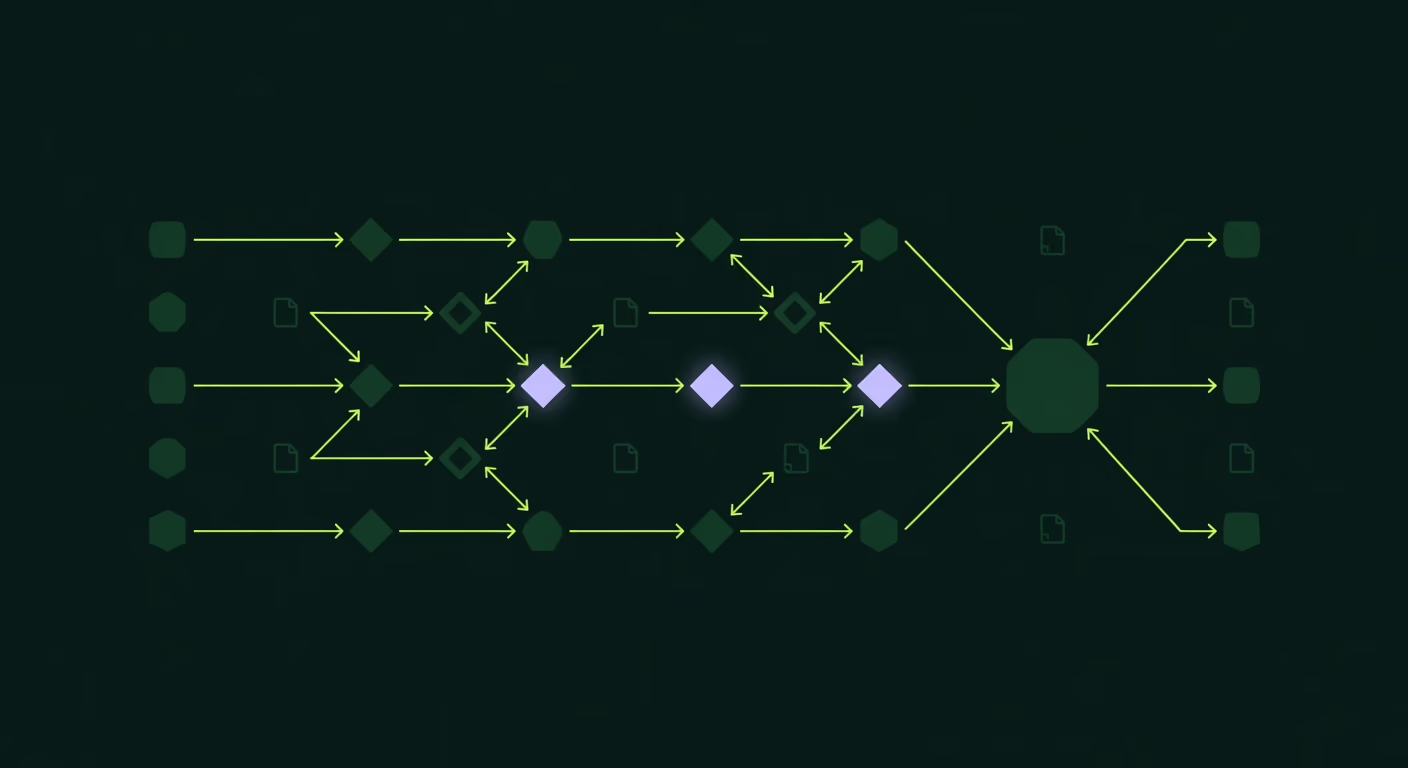
- Figure 1, Table 1, and Table 2 are structural and status summaries rather than measured research findings.
Where to go deeper
Readers whose requirement concerns supplier exposure rather than purchasing should read the SCR guide to supplier and third-party risk software, which covers the category this page deliberately excludes. The EDI and B2B integration guide covers the document exchange layer that electronic invoicing sits on. The ERP versus best-of-breed guide covers the general form of the suite decision in section 03. Readers scoping across categories should start with the SCR supply chain software category map, those building a business case should read the SCR software ROI method, and those preparing to evaluate products should read the SCR selection framework.
Sources
- EuropeanCommission. VATin the Digital Age package formally adopted, 11 March 2025.Primary. Source of the adoption date and the 2030 digital reportingdate.
- EuropeanCommission, Taxation and Customs Union. Adoptionof the VAT in the Digital Age package.Primary.
- EuropeanCommission. Europeanlegislation on electronic invoicing.Primary. Background on Directive 2014/55/EU and the standardizationmandate.
- EuropeanCommission. EN16931 compliance.Primary. The semantic standard and its bound syntaxes.
- OpenPeppol.Peppolinteroperability framework.Primary standards body. The four corner model and access pointarchitecture. OpenPeppol is a not-for-profit that owns thespecifications and has an interest in their adoption.
- EY.Francerevises the schedule for adopting electronic invoicing reform.Interested-party-adjacent: a professional services firm advising oncompliance. Used for legal status only.
- KPMG.France:delay in electronic invoicing and reporting implementation.Interested-party-adjacent; cited as evidence that these deadlineshave moved before.
- VATCalc.Franceposition on the September 2026 electronic invoicing and reportingdates.Specialist tax tracking service; corroborating source for the currentFrench position.
- EuropeanCommission. CommunicationCOM(2010) 712 on reaping the benefits of electronic invoicing forEurope.Primary, but the savings figure it contains is a 2010 forward-lookingprojection derived from commissioned consultant modeling, notmeasured outcomes.
Supply Chain Research is an independent, vendor-neutral research platform for supply chain and technology leaders. We accept no payment from the vendors, consultancies, or firms discussed. This article is analysis, not legal, procurement, or investment advice, and its conclusions should be validated against your own circumstances before any decision.
Want deeper analysis on vendors?
Related research


Research

Vendors
Company