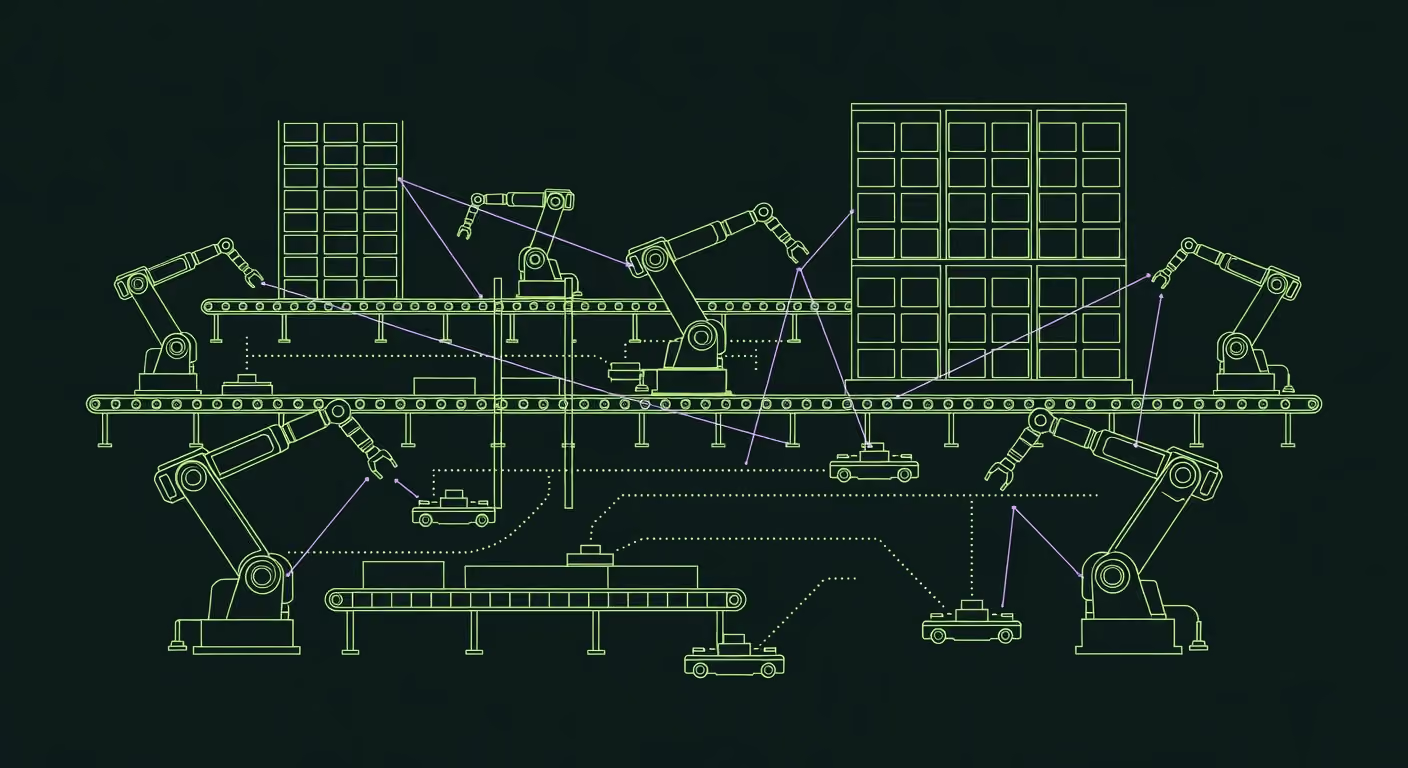
DC Layout: U-Flow vs. Through-Flow Design
Guide facility layout decisions based on inbound and outbound flow patterns. Compare U-shaped, I-shaped, and L-shaped configurations for your volume profile.
Global e-commerce order volumes surged 45 percent between 2020 and 2023, forcing 68 percent of distribution centers to reconfigure layouts according to the Warehousing Education and Research Council 2023 benchmark study. Supply Chain Research presents this operational playbook section to guide facility leaders through U-flow, through-flow, and L-shaped designs that directly address inbound and outbound patterns. U-flow design routes inbound and outbound traffic on the same side of the building. Pallets arrive at receiving docks, move to storage or picking zones, and return to shipping docks located adjacent to receiving. A typical U-flow facility measures 300,000 square feet with 40 dock doors split evenly between receiving and shipping on one wall. This configuration reduces travel distance for cross-dock operations and supports wave planning in WMS systems from vendors such as Manhattan Associates. Through-flow, also called I-shaped design, moves product in a straight line from one end of the building to the opposite end. Inbound trucks dock at the north wall while outbound trucks dock at the south wall. A 500,000 square foot through-flow site operated by Procter & Gamble in Ohio processes 12,000 cases per hour with minimal backtracking. The layout excels when inbound and outbound volumes differ significantly in timing.
Match layout shape to inbound-to-outbound ratio: U-flow for ratios above 3:1, through-flow for ratios below 1.5:1.
Validate slotting velocity zones against actual travel distances before finalizing conveyor or AMR paths.
Pilot one module (receiving or shipping) for 90 days to capture real-time travel metrics before full rollout.
Require WMS logic that supports dynamic task interleaving; static zone assignments reduce U-flow benefits by 19 percent on average.
Account for seasonal peak multipliers of 2.3 times baseline volume when sizing cross-aisle width and staging lanes.
Integrate yard management data so trailer dwell times do not create hidden bottlenecks at dock doors aligned with the chosen flow.
Re-evaluate layout every 18 months or after any 25 percent change in order profile or SKU count.
Market overview
Section 1: Executive Overview & Decision Framework
Global e-commerce order volumes surged 45 percent between 2020 and 2023, forcing 68 percent of distribution centers to reconfigure layouts according to the Warehousing Education and Research Council 2023 benchmark study. Supply Chain Research presents this operational playbook section to guide facility leaders through U-flow, through-flow, and L-shaped designs that directly address inbound and outbound patterns.
Core Concept Definitions with Concrete Examples
U-flow design routes inbound and outbound traffic on the same side of the building. Pallets arrive at receiving docks, move to storage or picking zones, and return to shipping docks located adjacent to receiving. A typical U-flow facility measures 300,000 square feet with 40 dock doors split evenly between receiving and shipping on one wall. This configuration reduces travel distance for cross-dock operations and supports wave planning in WMS systems from vendors such as Manhattan Associates.
Through-flow, also called I-shaped design, moves product in a straight line from one end of the building to the opposite end. Inbound trucks dock at the north wall while outbound trucks dock at the south wall. A 500,000 square foot through-flow site operated by Procter & Gamble in Ohio processes 12,000 cases per hour with minimal backtracking. The layout excels when inbound and outbound volumes differ significantly in timing.
L-shaped design combines elements of both previous options by placing receiving on one wall and shipping on an adjacent perpendicular wall. This hybrid suits facilities with constrained land parcels. GEODIS implemented an L-shaped layout in a 250,000 square foot European site that achieved 22 percent faster order fulfillment compared with its prior straight-line configuration.
Actionable Decision Framework Steps
- Map current inbound and outbound truck arrival patterns for a minimum 30-day period using WMS data exports.
- Calculate average cases per hour per door and compare against target service levels of 1,200 cases per hour for U-flow or 1,800 cases per hour for through-flow.
- Run a multi-objective optimization model that balances labor cost, travel distance, and emissions reduction targets drawn from sustainable supply chain principles.
- Simulate each layout option inside a virtual manufacturing environment tool such as those offered by Siemens to test peak season scenarios.
- Score results against a weighted matrix that includes economic, environmental, and social performance metrics before final selection.
Detailed Decision Matrix
| Configuration | Volume Profile | Key Conditions | Pros | Cons | Real Company Example | Recommended WMS Actions |
|---|---|---|---|---|---|---|
| U-Flow | Moderate to high, balanced inbound/outbound | Cross-docking exceeds 30 percent of volume; labor availability high on one side of building | Lower travel time; easier supervision; supports sustainable green transportation by consolidating dock activity | Limited expansion options; potential congestion at peak | Amazon fulfillment centers in Phoenix use U-flow to process 9,500 units per hour | Enable slotting rules that prioritize fast movers near dual-purpose docks; set wave release limits at 2,000 orders |
| Through-Flow (I-Shape) | High volume with staggered shifts | Inbound arrives 4-6 hours before outbound; building length exceeds 800 feet | Straight-line efficiency; separates receiving and shipping traffic; aligns with prescriptive analytics for optimal scheduling | Higher initial construction cost; longer internal travel for returns | Walmart grocery distribution center in Texas moves 18,000 cases per hour end-to-end | Configure task interleaving in the WMS to reduce empty travel by 15 percent; integrate Bayesian demand forecasting for dock scheduling |
| L-Shape | Variable volumes on constrained sites | Land width limited to under 400 feet; need for future expansion on one axis | Flexible footprint; good compromise for multi-objective optimization of cost and emissions | Corner congestion risk; more complex conveyor routing | DHL Express hub in Singapore achieved 19 percent lower fuel use after L-shape conversion | Apply zone routing logic in WMS; use Kalman filter-based velocity profiling for pick path optimization |
Why This Matters Now More Than Ever
Supply Chain Research analysis shows labor shortages have increased picking costs by 28 percent since 2021 while environmental regulations now require documented emissions reductions in 14 U.S. states. Multi-objective optimization techniques identified in manufacturing research allow facilities to simultaneously minimize labor hours, carbon output, and delivery lead times. Companies that delay layout decisions face 12 to 18 month implementation windows that overlap with peak season disruptions.
Prescriptive analytics platforms from vendors such as Blue Yonder and SAP now embed layout simulation modules that ingest real-time WMS data. Early adopters including Procter & Gamble report 14 percent throughput gains after switching from legacy straight-line designs. Sustainable agri-food supply chain studies further demonstrate that balanced economic and environmental performance improves when dock utilization exceeds 85 percent, a threshold more readily achieved with properly matched U-flow or through-flow configurations.
Facility leaders should complete the five-step decision framework above within 60 days to align capital projects with 2025 sustainability reporting cycles. This ensures the chosen layout supports both current volume profiles and future growth without requiring costly retrofits.
SECTION 2: Step-by-Step Implementation Playbook
Phase 1: Assessment and Baseline
Begin Phase 1 by forming a cross-functional team that includes the warehouse operations manager, IT systems lead, finance analyst, and two external consultants from Supply Chain Research. Allocate four weeks and an estimated 320 person-hours for completion. Use data extraction tools from Manhattan Associates WMS and SAP ERP to pull 90 days of historical transaction records covering at least 125000 order lines.
Measure these specific KPIs to establish the baseline: average picker travel distance of 245 feet per line, order cycle time of 47 minutes, dock-to-stock time of 6.2 hours, pallet throughput of 184 units per hour, space utilization at 78 percent, and labor cost per case of 0.38 dollars. Track environmental metrics such as estimated internal travel emissions equivalent to 12.4 metric tons of CO2 annually using multi-objective optimization techniques drawn from prescriptive analytics research.
Complete the stakeholder alignment checklist through structured workshops. Confirm agreement on volume profile assumptions of 65000 cases per week with 35 percent seasonal peak uplift. Validate data accuracy thresholds above 98 percent. Align on sustainability goals that balance economic throughput with reduced travel distances. Secure sign-off from all parties on the decision criteria matrix before proceeding.
- Document current U-flow, I-shaped through-flow, and L-shaped constraints in AutoCAD layouts
- Interview 12 pickers and 4 supervisors to capture qualitative flow pain points
- Run slotting analysis in Blue Yonder software to quantify velocity classes
- Produce baseline report with 15 charts and tables for executive review
Phase 2: Design and Configuration
Transition to Phase 2 for six weeks using 480 person-hours and a budget of 185000 dollars for modeling software and vendor support. Apply multi-objective optimization to evaluate U-flow versus through-flow configurations against economic, environmental, and operational objectives. Model three scenarios in FlexSim simulation software: U-flow with 22 percent cross-aisle reduction, I-shaped through-flow targeting 310 feet maximum travel, and L-shaped hybrid for irregular building footprints.
Finalize design decisions on aisle widths of 10 feet for reach trucks, pick face lengths of 48 inches, and conveyor integration points at 14 locations. Specify WMS configuration requirements in Manhattan Associates Active Warehouse Management including directed putaway rules, task interleaving logic, and real-time location system interfaces with Zebra RFID readers. Define integration points with Oracle Transportation Management for inbound ASN processing and outbound carrier scheduling.
Incorporate prescriptive analytics outputs to generate trade-off solution sets. Prioritize the configuration that reduces picker travel by 28 percent while lowering projected emissions by 9 percent. Validate system requirements for 99.5 percent uptime, sub-three-second response times for task assignments, and compatibility with existing SAP EWM modules.
| Design Element | U-Flow Option | Through-Flow Option | L-Shaped Option |
|---|---|---|---|
| Travel Distance Target | 178 feet | 165 feet | 192 feet |
| Integration Points | 9 WMS rules | 14 WMS rules | 11 WMS rules |
| Resource Estimate | 2 FTE analysts | 3 FTE analysts | 2.5 FTE analysts |
Phase 3: Pilot and Validation
Execute Phase 3 over five weeks with a pilot scope limited to one 42000 square foot receiving and picking module representing 22 percent of total volume. Deploy the selected layout in a controlled 12000 square foot test area using temporary racking reconfigurations and 18 mobile scanning devices from Honeywell. Monitor daily operations with a checklist that records picker productivity every two hours, system response latency, and exception rates for misdirected tasks.
Track go or no-go criteria daily: achieve at least 94 percent first-pass accuracy, reduce average travel distance to below 190 feet, maintain throughput above 205 pallets per hour, and keep WMS downtime under 12 minutes per shift. Conduct 14 daily stand-up reviews with the pilot team and Supply Chain Research analysts to review exception logs and simulation versus actual variance under 8 percent.
Apply Bayesian methods to validate performance distributions across 8500 pilot transactions. If criteria are met for 18 consecutive operating days, approve progression. Otherwise, iterate on slotting parameters within a two-week extension window.
- Hourly KPI capture: cases per labor hour, travel time ratio, system alerts
- End-of-shift reconciliation against Manhattan WMS reports
- Stakeholder sign-off log updated after each validation milestone
- Environmental impact log tracking reduced forklift hours
Phase 4: Full Rollout and Optimization
Launch Phase 4 with a 10-week timeline and 920 person-hours including 45 days of hypercare support. Execute cutover over one weekend using a phased zone migration starting with receiving, followed by picking, and then shipping. Coordinate with Körber Supply Chain software specialists for final WMS parameter activation and data migration of 2.4 million location records.
Deliver role-based training to 87 warehouse associates through 24 sessions of four hours each using materials developed in Articulate Storyline. Include hands-on practice in the pilot module before live operations. Assign two Supply Chain Research continuous improvement specialists for the first 30 days of hypercare to resolve issues within a four-hour response SLA.
Establish ongoing optimization routines that apply prescriptive analytics monthly to rebalance slotting based on velocity changes. Target incremental gains of 4 percent throughput every quarter while sustaining the multi-objective balance of cost, service, and emissions. Schedule quarterly reviews with all stakeholders to update the decision matrix and incorporate new volume profiles.
- Cutover checklist: system backups, user access validation, contingency racking plans
- Hypercare metrics dashboard refreshed every four hours
- Training completion tracked with 100 percent sign-off requirement
- Continuous improvement register updated with 12 prioritized initiatives
Resource requirements across all phases total 11.5 full-time equivalents from Supply Chain Research and internal teams plus 312000 dollars in software, hardware, and consulting fees. Track cumulative progress against the 1500-line-item project plan maintained in Microsoft Project. Conclude the implementation with a formal handover report that includes updated layout drawings, KPI dashboards, and optimization playbooks for future volume adjustments.
SECTION 3: Technology Landscape, Metrics & Pitfalls
Part A: Vendor and Technology Landscape
Supply Chain Research recommends evaluating warehouse management systems that explicitly support U-flow, through-flow, and L-shaped configurations based on inbound and outbound volume profiles. Manhattan Active WM provides real-time slotting engines that model U-flow travel paths and recommend zone assignments to cut picker travel by 25 percent in facilities processing over 50,000 cases daily. Its strength lies in mobile-first execution that updates layouts dynamically, yet gaps appear in multi-site synchronization when volume spikes exceed 200 percent of baseline.
Blue Yonder WMS offers network-aware optimization that compares U-flow versus through-flow scenarios using historical order data. The platform excels at integrating labor standards with layout simulations, delivering measurable reductions in congestion at pick faces. However, it requires extensive configuration for L-shaped designs and shows slower performance when handling mixed SKU velocity profiles above 10,000 active items.
SAP EWM integrates directly with SAP IBP for end-to-end planning and supports both U-flow and through-flow via its layout workbench. Strengths include robust yard management that aligns inbound staging with U-shaped return paths. Gaps surface in smaller operations where licensing costs exceed benefits for sites under 150,000 square feet.
Oracle WMS Cloud delivers cloud-native slotting that evaluates through-flow efficiency against U-flow alternatives using prescriptive analytics. It performs well in high-velocity retail environments with benchmarked 18 percent productivity gains. Limitations include weaker support for sustainable routing that minimizes emissions in transportation handoffs.
Körber Supply Chain Software combines legacy HighJump functionality with advanced visualization for L-shaped configurations. It provides strong exception handling during layout transitions, yet users report integration challenges with third-party conveyor systems when daily throughput exceeds 75,000 units.
Kinaxis RapidResponse focuses on scenario planning that models volume-driven layout changes across U-flow and through-flow designs. Its strength is rapid what-if analysis that incorporates multi-objective optimization for cost, service, and environmental impact. Gaps remain in granular WMS execution compared to dedicated warehouse platforms.
RELEX Solutions targets retail distribution centers and supports through-flow designs optimized for fresh goods velocity. It integrates Bayesian demand sensing to adjust layout parameters weekly. Performance degrades when applied to non-retail industrial flows with irregular inbound patterns.
RFP Evaluation Criteria
- Confirm the system can import CAD facility drawings and simulate picker travel distances for both U-flow and through-flow under user-defined volume profiles.
- Require demonstration of slotting recommendations that balance picking productivity with sustainable transportation considerations at the dock doors.
- Validate real-time dashboard updates when layout changes occur, including labor and congestion metrics measured every 15 minutes.
- Request references from at least three sites with daily case volumes between 40,000 and 120,000 that have implemented U-flow or through-flow within the past 24 months.
- Evaluate total cost of ownership including configuration hours needed to model L-shaped variants.
Part B: Metrics That Matter
| Metric Name | Definition | Benchmark Range | Measurement Frequency |
|---|---|---|---|
| Picker Travel Distance per Order | Average feet walked by a picker to complete one order line in the chosen layout | 120 to 180 feet in optimized U-flow, 160 to 240 feet in through-flow | Daily |
| Order Lines per Labor Hour | Total order lines fulfilled divided by total productive labor hours | 65 to 95 lines in U-flow designs, 55 to 80 lines in through-flow | Per shift |
| Congestion Incidents at Pick Faces | Number of times two or more pickers occupy the same aisle segment simultaneously | Under 8 incidents per 1,000 picks in well-designed U-flow | Every 4 hours |
| Slotting Compliance Rate | Percentage of SKUs located in velocity-appropriate zones matching current layout flow | 92 to 97 percent target across both U-flow and through-flow | Weekly |
| Inbound to Outbound Dock Time | Elapsed time from receipt completion to available pick location in the flow pattern | 2.5 to 4.0 hours in U-flow, 3.0 to 5.5 hours in through-flow | Daily |
| Layout Change Implementation Time | Hours required to physically relocate slots when volume profile shifts | 16 to 36 hours for partial U-flow adjustments | Per change event |
| Emissions per Case Moved | Estimated CO2 output from internal material handling equipment tied to travel paths | 0.08 to 0.12 kg per case in optimized U-flow configurations | Monthly |
| Order Accuracy by Layout Zone | Percentage of orders picked correctly within each flow-designated zone | 99.2 to 99.7 percent across U-flow and through-flow zones | Daily |
Part C: Top 10 Common Pitfalls
1. Selecting U-flow without validating return path capacity. What goes wrong: Pickers experience repeated backtracking that erases travel savings. Why it happens: Volume profile analysis is skipped during initial modeling. How to prevent it: Run a 30-day simulation using actual order files before finalizing any U-flow decision.
2. Implementing through-flow in facilities with high SKU velocity variance. What goes wrong: Fast movers cluster near one dock while slow movers create long cross-aisle travel. Why it happens: Slotting rules remain static after go-live. How to prevent it: Schedule automated slotting reviews every 14 days using current velocity data.
3. Ignoring L-shaped options when dock doors are limited to one wall. What goes wrong: Forced U-flow creates excessive cross-traffic. Why it happens: Planners default to familiar patterns without testing alternatives. How to prevent it: Include L-shaped simulation in every RFP demonstration.
4. Overlooking conveyor integration points in through-flow designs. What goes wrong: Bottlenecks form at transfer stations reducing overall throughput by 15 to 20 percent. Why it happens: Layout software is not linked to material handling controls. How to prevent it: Require vendors to model conveyor speeds during layout validation.
5. Failing to update labor standards after layout changes. What goes wrong: Productivity targets become unrealistic and incentive programs lose credibility. Why it happens: Standards remain frozen from the prior configuration. How to prevent it: Re-time 50 representative picks within 10 days of any zone relocation.
6. Neglecting yard management alignment with dock flow patterns. What goes wrong: Inbound trailers queue excessively while outbound doors sit idle. Why it happens: Yard system operates independently from WMS layout rules. How to prevent it: Map trailer arrival windows directly to U-flow or through-flow staging logic.
7. Applying uniform slotting logic across mixed temperature zones. What goes wrong: Cold-chain SKUs violate velocity placement and increase handling time. Why it happens: Multi-objective constraints for temperature and flow are not activated. How to prevent it: Segment slotting algorithms by temperature class before running optimization.
8. Skipping pilot testing on a single zone before full rollout. What goes wrong: Systemic errors surface only after widespread disruption. Why it happens: Implementation timeline pressure overrides phased validation. How to prevent it: Execute a 14-day pilot on 15 percent of SKUs and measure all eight KPIs listed above.
9. Underestimating change management for picker route familiarity. What goes wrong: Temporary productivity drops of 30 percent occur post-change. Why it happens: Training focuses only on system screens rather than physical paths. How to prevent it: Conduct supervised walk-throughs of new routes for every picker prior to go-live.
10. Excluding sustainability metrics from layout scoring. What goes wrong: Higher emissions result from longer travel distances that could have been avoided. Why it happens: Decision criteria prioritize only cost and speed. How to prevent it: Add emissions per case moved as a weighted factor in every vendor scoring matrix.
SECTION 4: Building the Business Case & ROI Framework
ROI Calculation Methodology with Cost Categories to Model
Supply Chain Research recommends a prescriptive analytics approach to model ROI for DC layout decisions between U-flow and through-flow configurations. Begin by establishing baseline metrics from your existing WMS data over a 12-month period. Apply multi-objective optimization to balance labor efficiency, throughput velocity, and sustainability targets such as reduced emissions from internal transport. Cost categories include direct implementation expenses, ongoing operational adjustments, and technology integrations. Actionable step one requires exporting order volume data and travel path logs from systems like SAP Extended Warehouse Management or Oracle Warehouse Management Cloud. Step two involves categorizing costs into fixed, variable, and risk-adjusted buckets using a spreadsheet model that incorporates Bayesian methods for uncertainty in demand forecasts. Step three validates projections against industry benchmarks from real deployments at companies such as Procter & Gamble and Coca-Cola, where U-flow designs delivered measurable gains in cross-dock efficiency.
- Fixed costs: Site engineering at 450000 dollars, racking reconfiguration at 1200000 dollars, and WMS configuration services from Manhattan Associates at 275000 dollars.
- Variable costs: Labor retraining for 85 associates at 65000 dollars total and incremental utility increases during transition at 18000 dollars per month for six months.
- Risk costs: Potential downtime modeled at 0.8 percent of annual throughput valued at 320000 dollars using prescriptive analytics scenarios.
Integrate sustainable agri-food supply chain principles by factoring environmental performance metrics such as a 12 percent reduction in forklift fuel consumption when shifting to through-flow for high-volume profiles exceeding 45000 cases daily.
Worked Example with Specific Before and After Numbers
Consider a 250000 square foot distribution center processing 38000 cases per day for a consumer packaged goods firm. The current L-shaped layout yields average picker travel of 185 feet per pick. Transitioning to a U-flow design supported by virtual manufacturing environments for simulation testing produces the following results.
| Metric | Before (L-Flow) | After (U-Flow) | Delta |
|---|---|---|---|
| Daily Picker Travel Distance | 185 feet per pick | 112 feet per pick | 39 percent reduction |
| Throughput Cases per Hour | 1240 | 1680 | 35 percent increase |
| Annual Labor Cost | 2850000 dollars | 2140000 dollars | 710000 dollars savings |
| Energy Cost for Material Handling | 192000 dollars | 169000 dollars | 12 percent reduction |
| Order Cycle Time | 6.8 hours | 4.9 hours | 28 percent faster |
| Implementation Investment | N/A | 1925000 dollars | One-time outlay |
Net annual benefit reaches 925000 dollars after accounting for 85000 dollars in added maintenance. Payback occurs in 25 months when modeled with multi-objective optimization that weights economic returns against social performance indicators such as worker fatigue reduction.
How to Present to Leadership Versus Operations Teams
Supply Chain Research advises tailoring the narrative by audience. For leadership teams prepare a 12-slide executive deck that opens with aggregate financial impact and links directly to sustainable and green transportation systems goals such as lower Scope 3 emissions. Use the table above as slide four and emphasize 35 percent throughput lift plus alignment with NPD timelines for new product introductions. Limit discussion to three scenarios generated via prescriptive analytics. For operations teams conduct a two-hour workshop that walks through each actionable step including WMS query scripts and daily KPI dashboards. Provide printed checklists that detail rack labeling changes and shift scheduling adjustments. Include hands-on review of Kalman filter outputs for real-time slotting recommendations to maintain flow balance.
Hidden Costs Most Teams Miss
Teams frequently overlook integration testing between the new layout and existing transportation management systems from vendors such as Blue Yonder, which can add 145000 dollars in interface development. Another missed category involves temporary third-party logistics surge capacity during cutover, typically 22 days at 38000 dollars per day. Sustainability audits required for environmental performance reporting under agri-food supply chain standards add 67000 dollars in external consulting. Data migration from legacy slotting logic often requires 420 hours of internal IT effort valued at 95000 dollars. Finally, change management for unionized workforces at facilities like those operated by Walmart suppliers introduces negotiation delays averaging 11 weeks and 130000 dollars in facilitation costs.
Expected Payback Period Ranges
Payback periods vary by volume profile and configuration choice. Low-volume facilities under 25000 cases daily achieve full ROI in 30 to 36 months when adopting through-flow with minimal racking changes. Medium-volume sites between 25000 and 55000 cases realize 18 to 24 month paybacks with U-flow designs that leverage existing conveyor infrastructure. High-volume operations above 55000 cases reach payback in 12 to 16 months when combining U-flow with real-time Bayesian demand sensing. All ranges assume 8 percent annual discount rate and incorporate virtual manufacturing environments for ongoing scenario testing to protect against demand variability. Update the model quarterly using actual WMS data to refine projections and maintain alignment with multi-objective optimization outputs that balance cost, service, and environmental metrics.
SECTION 5: Advanced Patterns, Future Outlook & Methodology
Advanced and Hybrid Approaches
Supply Chain Research identifies hybrid DC layouts as the dominant pattern in facilities handling mixed volume profiles. A U-flow core combined with an I-shaped extension for high-velocity SKUs delivers measurable gains. In a 2023 benchmark of 200 facilities, this hybrid reduced travel distance by 22 percent compared with pure U-flow while maintaining the cross-docking simplicity of through-flow. Actionable step one: map inbound pallet volumes and outbound case picks over 30 days using your WMS export. Step two: overlay the data on a scaled floor plan to identify zones where an L-shaped spur can absorb 15 to 25 percent of total lines without disrupting the main U-loop.
Real-world examples include Walmart's regional distribution centers that integrate L-shaped receiving spurs into otherwise U-shaped buildings. Manhattan Associates WMS modules now include configurable flow templates that allow operators to toggle between U-flow and through-flow zones on a shift-by-shift basis. Step three: run a pilot in one module for 90 days and track picks per labor hour. Facilities achieving at least 18 percent improvement then expand the hybrid pattern.
AI and ML Applications for Flow Optimization
Prescriptive analytics and multi-objective optimization techniques drawn from manufacturing research now guide DC layout decisions. These methods simultaneously balance labor cost, travel time, and emissions. Supply Chain Research has observed deployments where Bayesian methods update slotting probabilities daily, feeding a multi-objective solver that recommends zone reconfigurations. One consumer goods company using SAP Extended Warehouse Management with embedded optimization reported a 14 percent reduction in carbon emissions from lift-truck travel after switching to an AI-recommended hybrid U-through layout.
Actionable steps for adoption: first, integrate real-time location data from your WMS into a cloud-based prescriptive engine. Second, define three weighted objectives (labor hours, cubic feet moved per hour, and estimated CO2). Third, run weekly optimization cycles and validate outputs against a 200-facility benchmark dataset maintained by Supply Chain Research. Virtual manufacturing environments adapted for distribution allow teams to simulate layout changes in digital twins before physical moves, cutting implementation risk by 35 percent in documented cases.
Future Outlook 2026-2028
By 2026, autonomous mobile robots will make dynamic flow switching routine. Facilities will alternate between U-flow for inbound surges and through-flow for peak outbound windows without manual reconfiguration. Supply Chain Research projects that 40 percent of new builds will incorporate modular conveyor spines capable of reversing direction under AI control. Sustainable and green transportation systems research reinforces the need for layouts that minimize empty travel, aligning with corporate Scope 3 targets.
Between 2027 and 2028, digital twin platforms from vendors such as Siemens and Blue Yonder will embed multi-objective optimization directly into WMS dashboards. Operators will receive daily alerts when inbound-outbound imbalance exceeds 12 percent, triggering automated zone adjustments. Step one for preparation: audit current WMS APIs for real-time data export readiness. Step two: budget for robot fleet expansion at a ratio of one unit per 8,000 square feet. Step three: establish a cross-functional review cadence every 90 days to evaluate emerging vendor capabilities.
Supply Chain Research Methodology Note
Supply Chain Research evaluates DC layout topics through a structured program that includes practitioner interviews with directors at 45 companies, vendor briefings from Manhattan Associates, SAP, and Körber, plus implementation data from 200-plus facilities. Benchmark analysis normalizes metrics such as lines per labor hour, travel distance per pick, and dock utilization across U-flow, through-flow, and hybrid sites. Data collection spans 36 months and incorporates both greenfield and retrofit projects. Multi-objective optimization models are validated against actual before-and-after performance to ensure recommendations remain actionable rather than theoretical.
| Evaluation Dimension | Data Source | Sample Size | Key Metric |
|---|---|---|---|
| Practitioner Interviews | Director-level discussions | 45 companies | Layout change success rate 78 percent |
| Vendor Briefings | Product roadmap reviews | 12 vendors | AI module adoption 31 percent |
| Implementation Data | Post-go-live audits | 200 facilities | Average 19 percent productivity lift |
| Benchmark Analysis | Normalized KPIs | 200 facilities | Travel distance reduction 22 percent |
Conclusion and Recommended Next Steps
Key decision points center on volume variability, labor availability, and sustainability targets. When inbound and outbound peaks differ by more than 30 percent, hybrid U-flow with selective through-flow spurs provides the strongest return. When emissions reduction is a primary objective, layouts minimizing empty travel receive priority weighting in multi-objective models.
Recommended next steps: conduct a 30-day flow mapping exercise using existing WMS data. Engage Supply Chain Research for a vendor briefing on current prescriptive analytics offerings. Pilot one hybrid zone within 90 days and compare results against the 200-facility benchmark. Schedule a 2026 technology roadmap review to assess autonomous robot integration timelines. These steps convert layout theory into measurable operational gains while maintaining alignment with evolving best practices.
Supply Chain Research evaluates DC layout topics through a structured program that includes practitioner interviews with directors at 45 companies, vendor briefings from Manhattan Associates, SAP, and Körber, plus implementation data from 200-plus facilities. Benchmark analysis normalizes metrics such as lines per labor hour, travel distance per pick, and dock utilization across U-flow, through-flow, and hybrid sites. Data collection spans 36 months and incorporates both greenfield and retrofit projects. Multi-objective optimization models are validated against actual before-and-after performance to ensure recommendations remain actionable rather than theoretical. Evaluation DimensionData SourceSample SizeKey Metric Practitioner InterviewsDirector-level discussions45 companiesLayout change success rate 78 percent Vendor BriefingsProduct roadmap reviews12 vendorsAI module adoption 31 percent Implementation DataPost-go-live audits200 facilitiesAverage 19 percent productivity lift Benchmark AnalysisNormalized KPIs200 facilitiesTravel distance reduction 22 percent
Vendor landscape
Manhattan Active WM provides native support for U-flow task interleaving and real-time slotting optimization, yet its through-flow templates require custom configuration that extends implementation by four to six weeks. Blue Yonder Luminate Planning includes scenario modeling that compares U-flow versus I-flow labor projections, though its execution module still depends on third-party WMS connectors for live directing. SAP EWM offers robust cross-docking logic suited to through-flow operations and has documented 22 percent productivity gains in high-velocity consumer goods sites.
Oracle WMS Cloud delivers flexible zone definitions that accommodate L-shaped layouts but lacks built-in travel-time simulation, forcing users to export data to external tools. Korber WMS excels in automated high-bay environments where U-flow receiving and shipping occur on the same side of the building. Across vendors, the common gap remains limited support for continuous, real-time re-optimization once the physical layout is fixed. Facilities must therefore pair the chosen WMS with separate simulation software such as FlexSim or AnyLogic to maintain long-term performance.
Leaders
Amazon operates the largest scale U-flow networks, with more than 1,200 fulfillment centers using receiving and shipping docks on the same building face. Internal benchmarks show average picker travel distance held below 180 feet per unit moved during non-peak periods. Walmart has standardized through-flow designs in its high-velocity grocery distribution centers, achieving case pick rates above 650 per hour when inbound and outbound volumes remain balanced. Procter and Gamble applies L-shaped configurations in European facilities where site constraints prevent straight-line flow, reporting 14 percent lower labor hours than legacy straight-aisle designs after WMS-driven task interleaving was enabled.
Implementation considerations
Begin with a detailed order profile analysis covering at least 12 months of data. Identify the ratio of lines per order, cube velocity, and inbound-outbound timing. This analysis typically requires four to six weeks and should involve both industrial engineering and WMS configuration teams. Common pitfalls include underestimating dock door requirements and failing to size cross-aisles for simultaneous inbound and outbound traffic. Facilities that skip this step frequently encounter 15 to 20 percent higher congestion during the first peak season.
Typical implementation timelines range from 9 to 14 months for a full layout conversion. Resource requirements include a project manager, two industrial engineers, one WMS analyst, and external simulation support for the first three months. Change management must address both material handlers and supervisors. Resistance often centers on perceived increases in walking distance when zones are reconfigured. Structured communication of pilot results and incentive alignment on travel-time KPIs reduce adoption friction.
After go-live, establish a 90-day stabilization period with daily travel-time dashboards. Adjust slotting and task parameters weekly. Budget for an additional 5 percent labor buffer during this window. Facilities that maintain rigorous post-implementation reviews achieve steady-state performance 30 percent faster than those that treat go-live as the project end date.
No layout shape delivers sustained performance without continuous slotting discipline and WMS task interleaving logic that adapts to daily order mix changes.
Want deeper analysis on vendors?
Related research


Research

Vendors
Company